
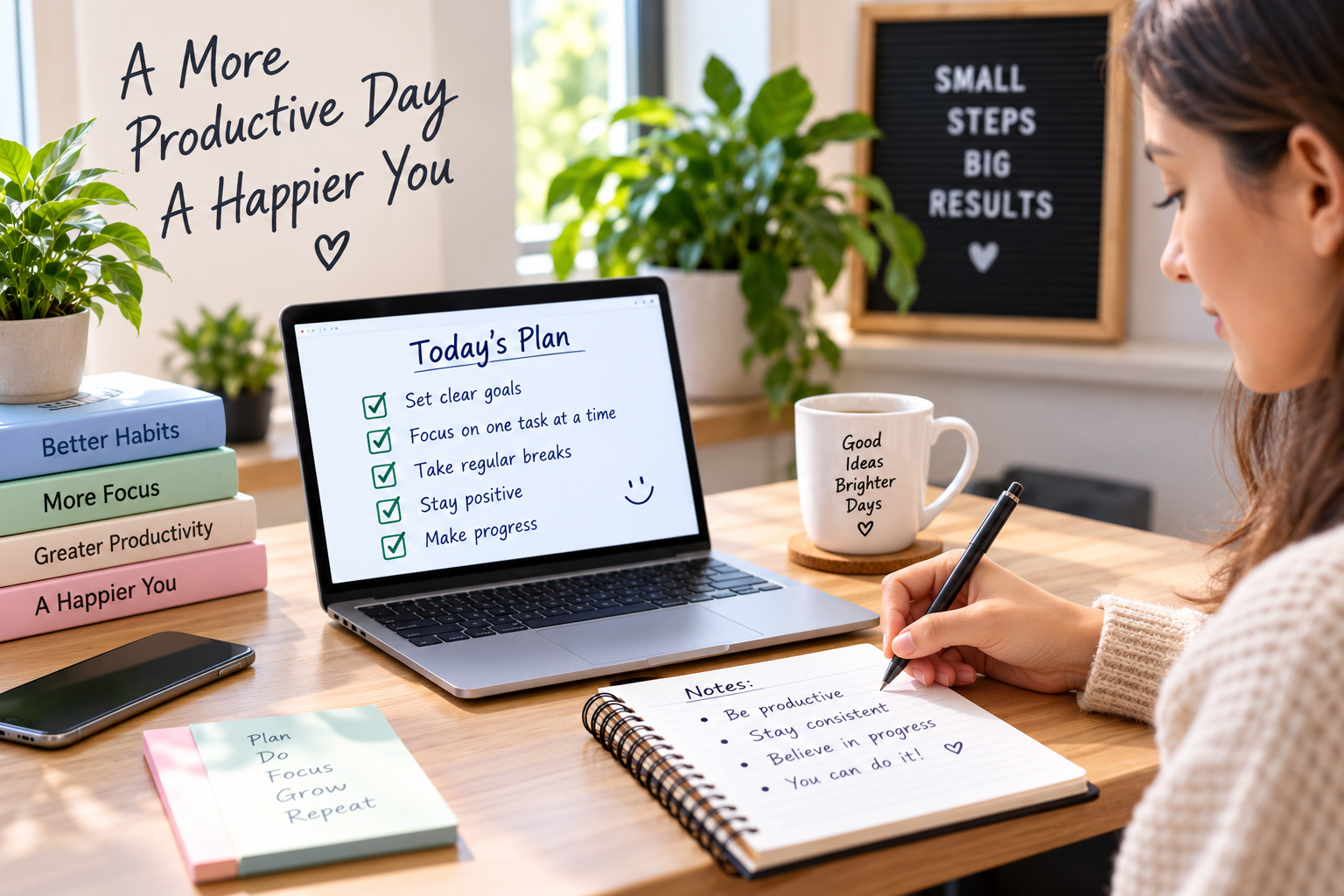
Being productive does not mean staying busy every minute of the day. Real productivity is about using your time wisely, focusing on important tasks, and making steady progress without constantly feeling overwhelmed.
If you often create a long to-do list but finish only a few tasks, small changes to your daily routine can make a big difference.
In this guide, you will learn how to be more productive with 10 simple habits that can help you improve focus, manage your time, reduce distractions, and get more important work done.
Table of Contents
- 1. Start With Clear Goals
- 2. Choose Your Top Priorities
- 3. Focus on One Task at a Time
- 4. Reduce Digital Distractions
- 5. Try Time Blocking
- 6. Take Regular Breaks
- 7. Create a Productive Workspace
- 8. Start Your Day With a Simple Routine
- 9. Avoid Letting Small Tasks Take Over
- 10. Review Your Day
- A Simple Productive Daily Routine
- Common Productivity Mistakes
- Frequently Asked Questions
- Final Thoughts
1. Start With Clear Goals
One of the easiest ways to lose productivity is to start the day without knowing what you actually want to accomplish.
Before beginning work, choose a few clear goals for the day. Instead of creating a huge list, focus on tasks that will make a meaningful difference.
For example, instead of writing:
- Work on project
- Check emails
- Do some research
Make the goals more specific:
- Finish the first section of the project
- Reply to important emails before lunch
- Complete 30 minutes of research
Clear goals make it easier to understand what progress looks like and help you stay focused.
2. Choose Your Top Priorities
You do not need to complete 20 tasks every day to have a productive day.
Choose two or three important tasks that deserve your attention first.
Ask yourself:
- What needs to be finished today?
- Which task has the biggest impact?
- What task will become a problem if I keep delaying it?
Complete your highest-priority work before spending too much time on less important tasks.
For more practical daily habits, read: 10 Daily Habits That Improve Productivity and Reduce Stress .
3. Focus on One Task at a Time
Multitasking can make your day feel busy, but constantly switching between tasks can make it harder to maintain focus.
The American Psychological Association discusses the challenges associated with switching between tasks and multitasking.
Learn more from the American Psychological Association .
Instead of doing several things at once, try choosing one important task and working on it for a specific period.
For example:
- Choose one important task.
- Close unnecessary browser tabs.
- Put your phone away.
- Work without switching tasks.
- Take a short break when needed.
Once you finish or reach a useful stopping point, move to the next task.
4. Reduce Digital Distractions
Your phone can interrupt your concentration even when you are not actively using it.
Notifications, social media, messages, and unnecessary browser tabs can quickly turn a short break into a long distraction.
Try these simple changes:
- Turn off unnecessary notifications.
- Keep your phone away while doing focused work.
- Close websites that are not related to your current task.
- Check social media during planned breaks instead of continuously.
- Use focus or do-not-disturb modes when appropriate.
If you are trying to reduce digital distractions, read our guide:
10 Simple Ways to Reduce Screen Time in 2026
You can also learn more about reducing notifications and staying focused through Microsoft's Focus feature .
5. Try Time Blocking
Time blocking means giving specific periods of your day to specific activities.
For example:
| Time | Activity |
|---|---|
| 9:00 AM – 10:30 AM | Important project work |
| 10:30 AM – 10:45 AM | Short break |
| 10:45 AM – 12:00 PM | Research and writing |
| 12:00 PM – 1:00 PM | Lunch and rest |
| 1:00 PM – 2:00 PM | Emails and smaller tasks |
| 2:00 PM – 3:30 PM | Focused work |
Your schedule does not need to look exactly like this. The idea is to give important work a dedicated place in your day.
6. Take Regular Breaks
Working continuously for hours is not always the best way to stay focused.
Short breaks give you an opportunity to stand up, stretch, drink water, or simply step away from your screen.
A break does not have to become a long social-media session. Keep it simple and return to your task when the break is over.
- Stand up and move around.
- Drink some water.
- Stretch for a few minutes.
- Look away from your screen.
- Take a short walk if possible.
7. Create a Productive Workspace
Your environment can influence how easy it is to concentrate.
You do not need a perfect home office. Start with a few basics:
- Keep your main workspace reasonably tidy.
- Keep frequently used items nearby.
- Remove unnecessary items from your desk.
- Make sure your screen is positioned comfortably.
- Keep distractions away from your main work area.
If you work from home, you may also find our guide useful:
10 Simple Ways to Stay Focused While Working From Home in 2026
8. Start Your Day With a Simple Routine
A predictable morning routine can help you transition into your day.
Your routine could include:
- Getting up at a consistent time
- Drinking water
- Getting ready without immediately checking social media
- Reviewing your priorities
- Starting your most important task
You do not need a complicated morning routine.
For more ideas, read:
How to Build a Simple Morning Routine That Actually Works
9. Avoid Letting Small Tasks Take Over
Small tasks can make you feel productive because they are easy to complete. However, spending your entire day on small tasks can leave important work unfinished.
Group similar small tasks together whenever possible.
For example, instead of checking email every few minutes, choose specific times to review and respond to messages.
This leaves larger blocks of uninterrupted time for important work.
10. Review Your Day
Spend five minutes at the end of your workday reviewing what happened.
Ask yourself:
- What did I complete today?
- What did I not finish?
- What caused the biggest distraction?
- What should I prioritize tomorrow?
This simple review can help you identify patterns and gradually improve your routine.
A Simple Productive Daily Routine
Here is an example of a simple productivity routine:
- Start the day by reviewing your priorities.
- Choose two or three important tasks.
- Complete your most important task first.
- Take short breaks between focused work periods.
- Check messages during planned times.
- Keep your workspace organized.
- Finish the day with a short review.
- Prepare your priorities for tomorrow.
The goal is not to follow this schedule perfectly. The goal is to create a structure that makes your important work easier to complete.
Common Productivity Mistakes
Avoiding a few common mistakes can make your routine much easier.
- Creating an unrealistic to-do list
- Trying to multitask constantly
- Checking your phone every few minutes
- Spending too much time on low-priority tasks
- Skipping breaks completely
- Working without clear goals
- Trying to make your routine too complicated
How to Stay Productive Without Feeling Overwhelmed
Productivity should help you manage your responsibilities, not make every minute of your day feel stressful.
If your task list becomes overwhelming, reduce it to the most important items.
You can also divide a large task into smaller steps. Completing one small step gives you a clear starting point and makes the larger project feel more manageable.
Remember that a productive day does not have to mean completing everything.
Sometimes the best result is simply making meaningful progress on the work that matters most.
Frequently Asked Questions
How can I be more productive every day?
Start by choosing a few clear priorities, reducing distractions, focusing on one task at a time, taking regular breaks, and reviewing your progress at the end of the day.
What is the best productivity habit?
There is no single productivity habit that works for everyone. A useful starting point is choosing clear priorities and protecting focused time for important work.
How can I stop getting distracted by my phone?
Turn off unnecessary notifications, use a focus mode, and keep your phone away from your workspace during important tasks.
If your phone is also running slowly, you can read: How to Make Your Phone Faster .
Should I multitask to get more done?
Instead of constantly switching between tasks, try focusing on one important task at a time. This can make it easier to maintain concentration.
How many tasks should I plan for one day?
There is no universal number. Start with two or three important priorities and add smaller tasks around them if you have enough time.
How can I become productive when I do not feel motivated?
Start with a very small step. Open the document, write the first sentence, organize the first item, or work for a short period. Starting can make the task feel easier to continue.
Final Thoughts
Learning how to be more productive is not about working constantly.
It is about making your time more intentional. Set clear goals, choose your priorities, reduce distractions, protect focused work time, take breaks, and review your progress.
Start with one or two habits instead of changing everything at once. Once those habits become natural, add another improvement.
Small improvements repeated consistently can create a much more productive day.
For more practical productivity, technology, lifestyle, and everyday guides, visit: WriteHubDaily .
Disclaimer: This article provides general productivity and lifestyle information for educational purposes. Individual schedules, responsibilities, and working conditions vary, so choose habits that are appropriate for your situation.